
Online Payment Collection Options for Installment Businesses in Pakistan
Installment business terminology in Pakistan mixes English business vocabulary with Urdu words that don’t always have a clean English equivalent — jurmana isn’t quite “late fee,” zamanat isn’t quite “guarantee.” This qist glossary covers the installment business terms Pakistan shop owners actually use, including common online payment collection options, organized by category so you can find what you need fast. Use the search box below to jump straight to a term, or browse by section.
Payment & Late Fee Terms and Online Payment Collection Options
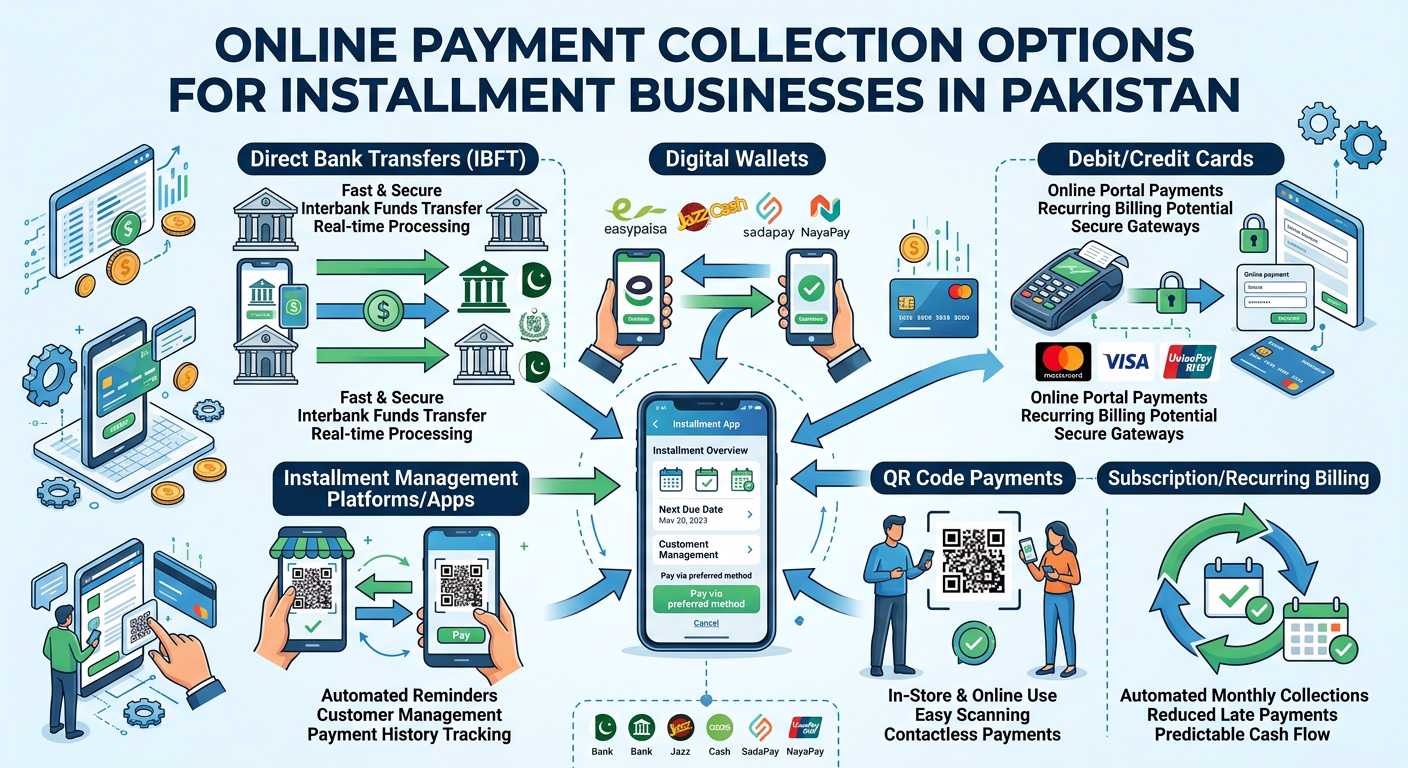
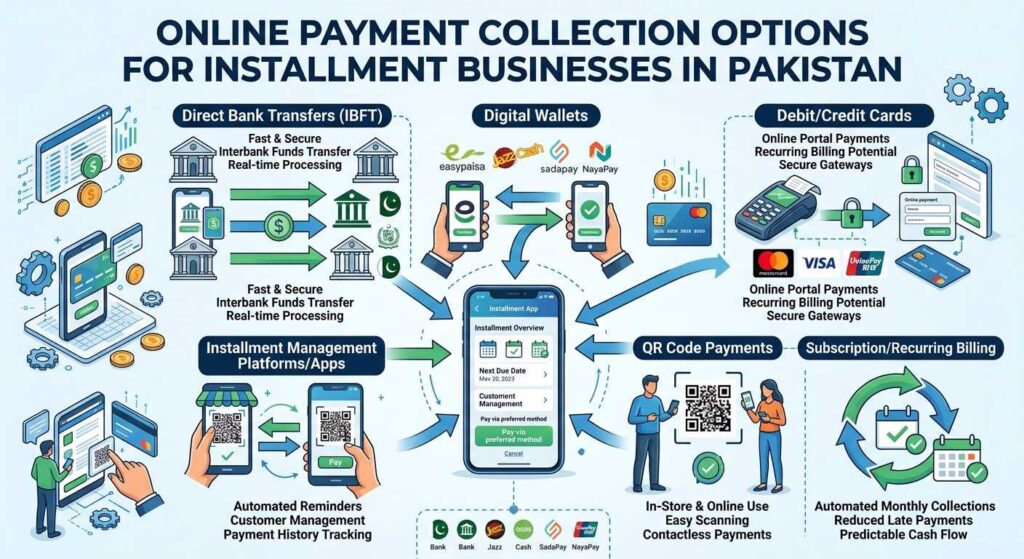
For installment businesses, online payment collection options can include bank transfers, digital payment services, QR-based payments, and other methods that help customers pay without visiting the shop. The right method depends on how your business records payments, confirms transactions, and updates each customer’s outstanding balance. Pakistan’s State Bank of Pakistan information on Raast is a useful reference when reviewing digital payment options for merchants.
The general Urdu term for “installment” — a fixed periodic payment made toward the total price of a purchase. The word behind “qist software” and most of the industry’s everyday vocabulary.
An alternate spelling and plural form of qist — “kishton mein” means “in installments.” Used interchangeably with qist in everyday conversation and in some regional dialects.
The formal Urdu plural of qist, meaning “installments” — more common in written or legal contexts (contracts, formal notices) than in spoken shop-floor conversation.
Equated Monthly Installment — functionally the same as qist, but the term is more associated with formal bank loans and financing than retail shop sales.
The upfront portion paid at the time of sale before the installment plan begins — typically 20–30% of the total price in Pakistani retail qist sales. Businesses may also review online payment collection options when deciding how customers can pay future installments.
A late fee or penalty charged when an installment isn’t paid by its due date — usually calculated as a percentage of the overdue amount per week or per day late. See our full jurmana calculation guide.
General credit or “on account” — money owed for goods received without immediate full payment. Broader than qist; udhaar doesn’t imply a fixed schedule the way an installment plan does.
A running account or ledger tracking what a customer owes — the basis of “khata apps” used for general credit tracking, distinct from structured installment schedules.
The remaining amount a customer still owes on their installment plan at any given point — total price minus down payment and all payments made so far.
People & Roles
Also called zamin — a second person who agrees to take financial responsibility for a buyer’s installment plan if the buyer defaults. See our guarantor management system.
The guarantee or surety a guarantor provides — the formal obligation itself, distinct from the guarantor (zamin) who is the person providing it.
A customer who has stopped paying their installments, typically after missing several consecutive payments — the point at which a plan is formally considered in default.
Field staff responsible for following up on overdue accounts — phone calls, visits, and coordinating with guarantors on unresolved cases.
Computerized National Identity Card — Pakistan’s national ID, and the standard identity document collected from every buyer and guarantor before an installment sale.
Legal & Documentation
Legal paper used for formal agreements in Pakistan, giving a signed contract stronger standing if a dispute ever needs to go to court — typically used for higher-value installment sales.
The signed contract covering price, schedule, jurmana rate, and guarantor obligations for an installment sale. See our agreement format guide and free template.
A cost-plus sale structure used in Islamic finance — the seller discloses cost and markup, and sells at a fixed total price rather than charging interest over time.
Interest — prohibited in Islamic finance. Murabaha-style structuring is commonly used to avoid riba in installment sales. See our halal installment business guide.
National Tax Number, issued by the FBR — required for formal business registration and a standard part of installment business licensing in Pakistan.
Business & Software Terms
A report showing overdue balances grouped into buckets — current, 1–30 days late, 31–60 days, 60+ — used to assess portfolio risk at a glance. It can also help businesses compare how online payment collection options affect payment follow-up and outstanding balances.
The ability to run and monitor several shop locations from one system, with consolidated head-office reporting. See our multi-branch system.
Field-based payment collection where a recovery officer visits the customer’s home or business directly, common for higher-touch or higher-risk accounts. It can be used alongside online payment collection options when customers prefer digital payments.
The full breakdown of an installment plan — amount, due date, and sequence for every payment from down payment to final installment. A clear schedule makes it easier to connect online payment collection options with each customer’s expected payment dates.
The total set of active installment plans a business is currently managing — used when discussing overall risk, collection rate, or business health.
A system feature that limits what each staff member can view or edit based on their role — e.g. a cashier can’t alter guarantor records the way a manager can.
See These Terms Applied in a Real System
QistBook uses this exact terminology throughout — jurmana calculation, guarantor records, aging reports, and multi-branch management, with support for workflows that can include online payment collection options for installment customers.
Frequently Asked Questions

Ahsan
I focus on the practical side of running a credit-based retail business, with a particular interest in customer verification, guarantor management, recovery procedures, and reducing the risks associated with installment sales. I share practical guidance based on the situations retailers commonly face, helping business owners build stronger processes for approving customers and handling credit responsibly.
View all posts →