
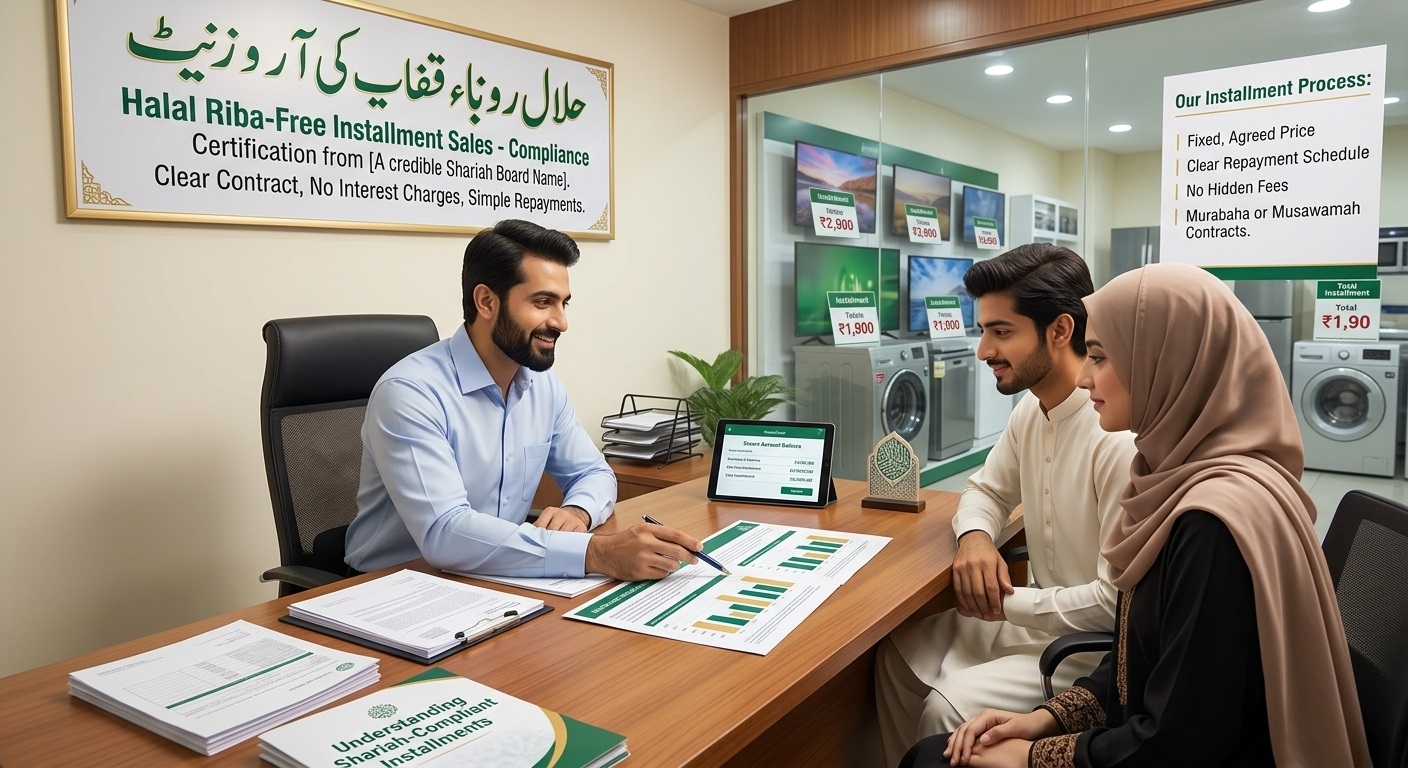
Halal Installment Business Practices: Riba-Free Installment Sales in Pakistan
Pakistan is an overwhelmingly Muslim-majority market, and a meaningful share of customers deciding whether to buy something on installment are also asking a second question at the same time: is this actually halal? For a business selling on qist, that’s not an abstract concern — it directly shapes how the price is set, how a late payment is handled, and what the agreement actually says.
Before anything else: this post explains commonly accepted general principles that installment businesses use to structure sales in a way that avoids interest (riba). It is educational content, not a religious ruling. Whether a specific business practice qualifies as halal is a matter of Islamic jurisprudence — for formal certification or a binding opinion on your specific structure, consult a qualified Shariah scholar or Islamic finance advisor.
This guide covers what a halal installment business in Pakistan generally looks like in practice — the difference between riba-free installment structuring and interest-based lending, how an Islamic installment sale is typically set up, and the halal qist practices around late payments that come up most often for shop owners trying to get this right.
Interest-Based Lending vs Fixed-Price Structuring
The core distinction that separates a conventional interest-bearing loan from the structure most Islamic installment sales use.
Interest Charged on a Cash Loan
Money is lent, and a percentage is charged on top purely for the use of that money over time — the cost grows the longer the loan runs, independent of any actual goods or trade.
Fixed Price Agreed at the Point of Sale
The business sells an actual item at a total price agreed upfront — the price doesn’t change based on how long the customer takes to pay, because it was never a loan of money in the first place.
The structure many Islamic installment sales are based on is often referred to as murabaha, or cost-plus sale — commonly used in Islamic banking and increasingly by retail installment businesses. The idea, at a general level, is that the seller takes on genuine ownership of the item before selling it to the customer at a disclosed, fixed markup, rather than simply lending cash and charging interest on the loan. In practice, for a retail installment business, this often means the shop purchases the phone, appliance, or vehicle from its own supplier first — as it would for any normal sale — and then resells it to the customer at an agreed total price that already reflects the seller’s profit margin, made explicit rather than folded invisibly into an interest rate.
Principles Behind Halal Qist Practices
Five ideas that come up consistently in how Islamic installment sales are commonly structured.
Genuine Ownership Before Sale
The seller should actually hold or control the item — not merely act as a financing pass-through — before transferring it to the buyer.
Price Fixed Once, Not Renegotiated
The total price agreed at signing stays the same regardless of how the payment schedule plays out, avoiding any resemblance to compounding interest.
Full Transparency on Cost and Markup
Many scholars consider disclosure of the cost price and profit margin an important feature of a proper murabaha-style sale.
No Compounding on Late Payments
A late fee that grows the longer a payment is delayed starts to resemble interest — flat, one-time charges are more commonly accepted.
Late Fees Routed to Charity, Not Profit
Some scholars hold that any late-payment charge should be donated to charity rather than kept as business income, to avoid it becoming a disguised form of riba.
On late fees specifically: this is one of the more debated areas in Islamic finance. Approaches vary — some scholars permit a fixed penalty retained by the business as compensation for genuine loss, others hold it should go to charity, and some avoid any late fee at all in favor of other deterrents. If getting this specific point right matters to your business, it’s worth a direct conversation with a Shariah advisor rather than relying on general guidance.
Why This Is a Commercial Question, Not Just a Religious One
Structuring around these principles isn’t only about compliance — it changes how customers see the offer.
A retailer who can clearly explain that their installment pricing is fixed at signing, with no hidden interest and no compounding penalty, is offering something meaningfully different from a generic qist plan — even to customers who wouldn’t describe themselves as strictly seeking Shariah-compliant products. Transparency on cost and markup tends to build trust regardless of the religious framing, because it answers the exact question every installment customer is quietly asking anyway: what am I actually going to end up paying in total, and can that number change on me later.
For businesses that do want to market explicitly around the halal angle, the commercial upside is real — Timeline Digital, one of the installment software players in this space, already leans into halal-friendly messaging, and no competitor has built a genuinely deep content or product story around it yet. A business that gets the underlying structure right, with real scholarly input rather than a surface-level claim, has room to build a durable reputation advantage that’s difficult for a competitor to copy quickly.
Structure Your Installment Terms However Your Business Requires
QistBook lets you set fixed pricing, custom late-fee policies, and full payment transparency for every customer — configured to match how your business actually wants to operate.
Frequently Asked Questions
Explore More from QistBook

Ahsan
I focus on the practical side of running a credit-based retail business, with a particular interest in customer verification, guarantor management, recovery procedures, and reducing the risks associated with installment sales. I share practical guidance based on the situations retailers commonly face, helping business owners build stronger processes for approving customers and handling credit responsibly.
View all posts →