
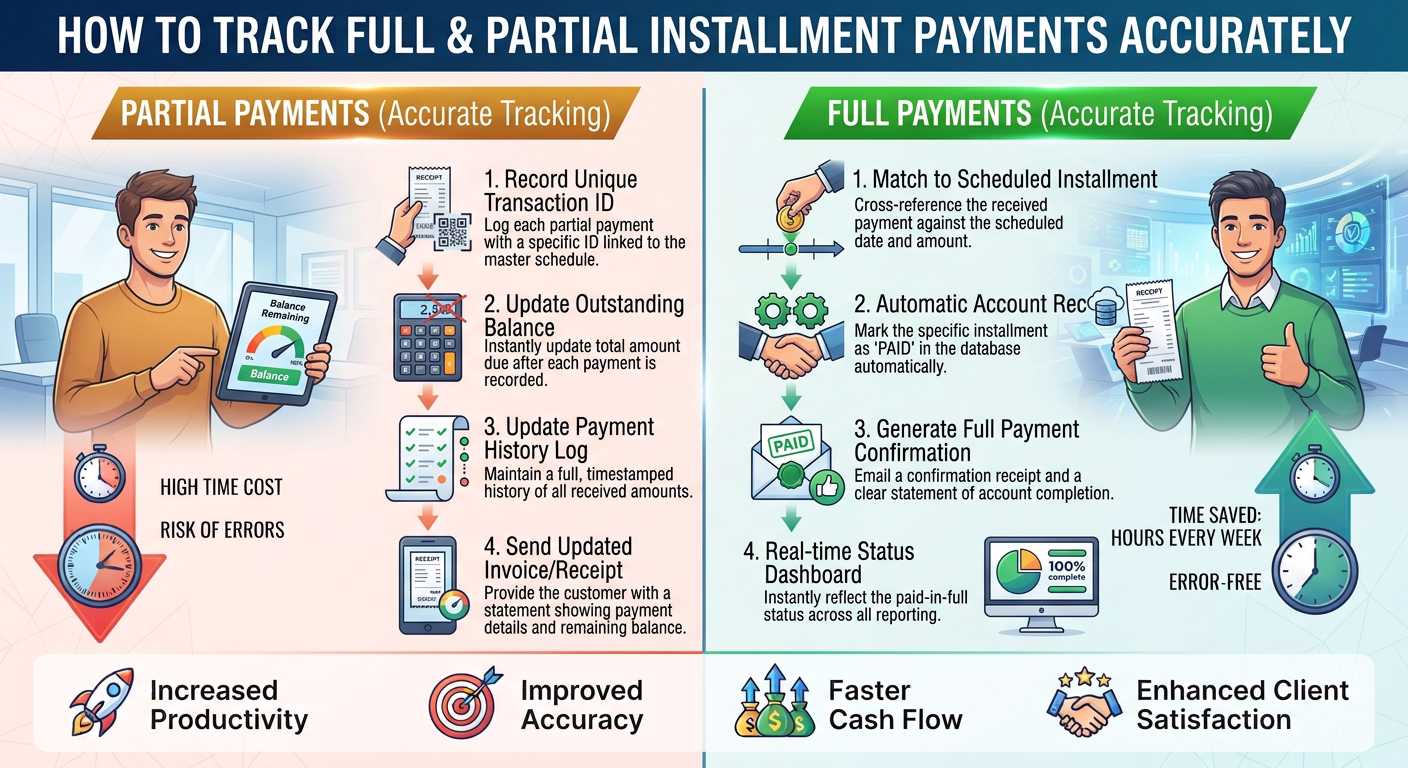
How to Track Full and Partial Installment Payments Accurately
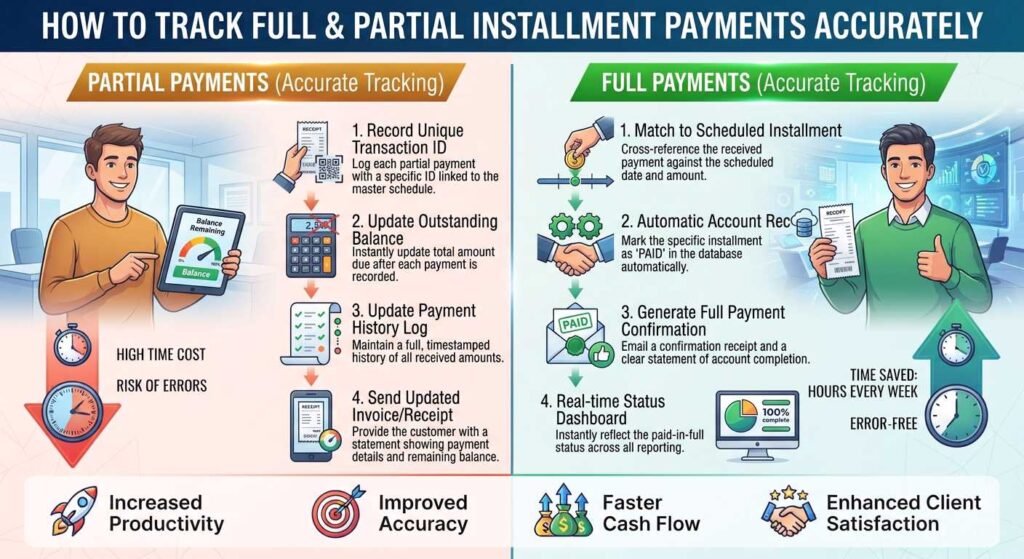
How to Track Full and Partial Installment Payments Accurately
A customer paying Rs 5,000 against a Rs 9,000 installment isn’t a rounding error — it’s information. Here’s how to track full and partial installment payments accurately, so nothing gets lost between the payment and the balance sheet.
Full payments are easy. A customer owes Rs 9,000 for this month, they pay Rs 9,000, the installment is marked paid, done. Partial payments are where most manual tracking systems start to show cracks — and in a lot of Pakistani retail installment businesses, partial payments aren’t the exception, they’re routine.
The core rule: partial payments apply to the oldest unpaid installment
When a customer pays less than the full installment amount, that partial payment should be applied to whichever installment is oldest and still unpaid — not spread evenly across future installments, and not just subtracted from some abstract total balance. This keeps the schedule honest: it’s always clear exactly which installment number is still short, and by how much.
This sounds obvious written out as a table. On paper, under pressure, with a queue of customers waiting, it’s exactly the kind of entry that gets simplified into “customer paid something, will settle rest later” — which is technically true and practically useless three weeks from now when nobody remembers the exact number.
Why a single running balance isn’t enough
Some businesses track partial payments by just reducing an overall balance figure — customer owed Rs 90,000 total, now owes Rs 85,000. That number is correct, but it hides which specific installment is short and by how much, which matters the moment a late fee needs calculating or a dispute comes up. “You still owe Rs 85,000” is a much weaker position in a conversation than “Installment 6 is Rs 4,000 short, and Installment 7 hasn’t been touched yet.”
A running total hides the shape of the problem. Two customers can both owe Rs 85,000 — one because they’re consistently Rs 500 short every month, the other because they haven’t paid anything in two months. Those are very different situations that a single number can’t distinguish between.
Recording the payment method matters too
Beyond the amount, noting how a payment was made — cash, JazzCash, EasyPaisa, bank transfer — matters for reconciliation at the end of the day or week. A business collecting through multiple channels without recording which one was used for each payment eventually runs into a mismatch between what the ledger says and what actually landed in the account, and untangling that after the fact is far harder than recording it correctly the first time.
What this looks like at scale
One customer, one partial payment, is manageable by memory. A business with two hundred active installment plans, several of which have partial payment history stretching back months, is not something any person can hold accurately in their head — or reliably reconstruct from a register where partials were noted as quick margin scribbles rather than proper entries. This is one of the more common places where a business’s actual financial picture quietly diverges from what the owner believes it to be, simply because partial payments were never tracked with enough precision to add up correctly.
A common failure pattern worth watching for
One pattern shows up often enough to be worth naming directly: a customer who consistently pays slightly under the full installment amount, month after month, without anyone flagging it as a pattern. Each individual shortfall looks minor — Rs 300 here, Rs 500 there — and gets waved through because chasing it feels disproportionate to the amount. Over a year, on a single customer, that can add up to a missed installment’s worth of money that nobody consciously decided to forgive. The only way to catch this is to track partial installment payments precisely enough that the pattern becomes visible, rather than each instance being evaluated in isolation as “close enough.”
This is also where the oldest-installment-first rule earns its keep. If partials are tracked properly against specific installments rather than a vague total, a running shortfall shows up clearly as a growing gap on early installments, even while later installments technically show as paid. Businesses relying on total-balance tracking often don’t see this until it’s already a meaningful sum, because the total balance figure alone doesn’t reveal that the shortfall is concentrated and recurring rather than random.
Every partial payment, tracked precisely
QistBook applies partial payments to the correct installment automatically and keeps an exact record of what’s still owed.
Frequently Asked Questions
How should a partial installment payment be recorded?
A partial payment should be applied to the oldest unpaid installment first, with the remaining balance on that installment clearly shown, rather than being logged as a vague reduction to the total balance owed.
What happens if partial payments are tracked as a single running total instead of per installment?
It becomes difficult to know exactly which installment is still short, which complicates late fee calculations and makes disputes with customers harder to resolve with confidence.
Should a business accept partial payments at all?
Most retail installment businesses in Pakistan do, since refusing a partial payment often means getting nothing instead. The key is recording it accurately rather than deciding whether to accept it.
Related reading

Umaira
I explore the people and processes behind successful installment businesses, including customer relationships, sales practices, staff workflows, and everyday challenges faced by retailers. Through my writing, I aim to present useful ideas and real-world approaches that make complex business practices easier to understand and apply in a busy retail environment.
View all posts →