
How Automating Installment Schedule Generation Saves Hours Every Week
How Automating Installment Schedule Generation Saves Hours Every Week
Building one installment schedule by hand takes a few minutes. Building forty of them a week, correctly, every week, is a different kind of problem entirely — which is exactly why businesses automate installment schedule generation once volume grows past what one person can double-check reliably.
Every installment sale needs a schedule — how many payments, how much each one is, when each is due. For a single sale, working this out by hand is trivial: divide the balance by the number of months, note the dates, done. The trouble isn’t any individual calculation. It’s doing that calculation correctly, consistently, dozens of times a week, without a mistake creeping in on a day when the shop is busy and someone’s rushing.
Where manual schedule calculation actually breaks down
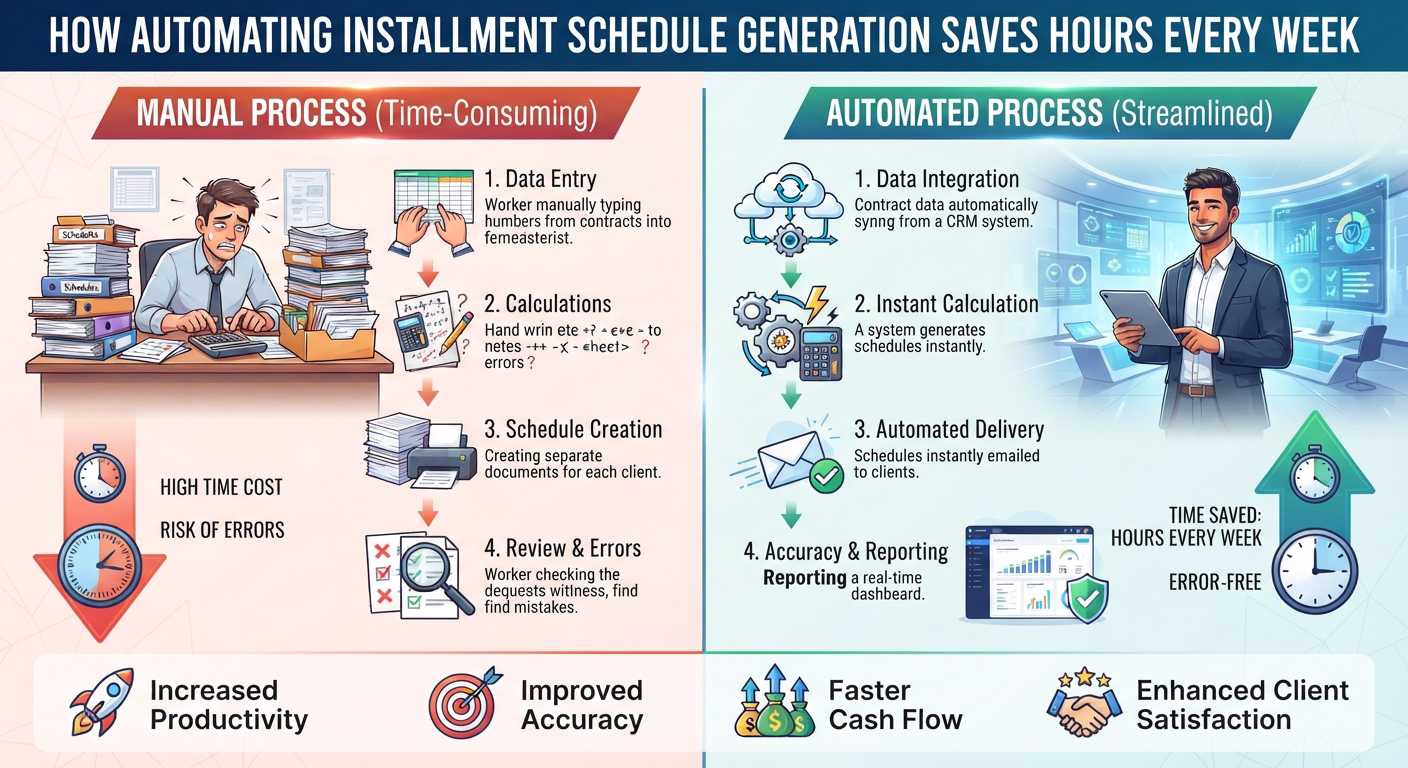
Industry research on manual billing processes puts error rates for hand-calculated schedules and statements somewhere between 3-5%, compared to under 1% for automated, rule-based generation. That gap doesn’t sound dramatic until it’s applied to volume — a business processing 60 installment sales a month at a 4% manual error rate is looking at two to three schedules a month with something wrong in them, whether that’s a miscalculated monthly amount, a wrong due date, or a down payment that wasn’t properly subtracted first.
What automatic schedule generation actually does
Given a total price, a down payment, a plan length, and a start date, automated schedule generation calculates every installment amount and due date instantly, correctly accounting for the down payment already subtracted and any processing fees. It removes the manual arithmetic step entirely — the business enters the terms once, and the schedule exists, ready to reference for every future payment and reminder.
Where the time savings actually come from
The direct time saved on any single schedule is real but modest — a few minutes per sale. The larger savings show up downstream: a correctly generated schedule means every reminder, every balance check, and every late fee calculation that follows is built on accurate data from the start. Manually generated schedules with small errors tend to require correction later, often discovered mid-dispute rather than caught early — and fixing a schedule three months into a plan, after several payments have already been recorded against the wrong numbers, takes far longer than getting it right on day one would have.
The real cost of a schedule error isn’t the fix — it’s the trust. A customer who catches their own installment schedule being wrong starts questioning every other number the business has given them, even ones that were correct.
Handling plans that aren’t simple and even
Not every installment plan divides neatly. A customer might negotiate an uneven schedule — a larger final payment, a skipped month around Eid, a mid-plan adjustment after a partial early payment. Good schedule automation needs to handle these cases, not just the straightforward fixed-amount, fixed-frequency plans that are easy to calculate by hand anyway. This is actually where automation earns its keep the most: the irregular cases are exactly the ones most prone to manual calculation errors, since they can’t be solved with a simple division.
What this looks like across a growing business
A single-counter shop doing a handful of installment sales a week might not notice much difference between manual and automated schedule generation — the volume is low enough that mistakes, when they happen, are caught quickly. The picture changes entirely once a business has multiple branches and staff who aren’t the owner generating schedules. At that scale, consistency matters as much as accuracy: every schedule needs to follow the same rules regardless of which branch or staff member created it, and manual processes tend to drift — different people rounding differently, applying fees inconsistently, or simply making more mistakes under higher volume pressure.
The staff training angle nobody mentions
There’s a secondary benefit to automating schedule generation that rarely comes up in the time-savings pitch: it removes a whole category of training burden. Teaching a new staff member to correctly calculate an installment schedule by hand — accounting for down payments, processing fees, and the business’s specific rounding conventions — takes real time and produces real mistakes during the learning curve. A system that generates the schedule automatically, correctly, every time, means a new hire can be productive on day one without first mastering a manual calculation process that took the owner years to get comfortable with. For businesses that see regular staff turnover, this alone can justify the switch.
Beyond time: what accuracy actually protects
Time saved is the easy benefit to point to, but the accuracy gain matters just as much in practice. A correct schedule from day one means recovery conversations, aging reports, and guarantor discussions are all working from the same reliable numbers. An incorrect one means every downstream process inherits the original error, often without anyone realizing it until a customer disputes a balance that was wrong from the very first calculation.
Every schedule generated correctly, instantly
QistBook calculates installment schedules automatically — down payments, fees, and irregular plans included.
Schedule a DemoFrequently Asked Questions
How much time does automating installment schedule generation actually save?
For a business processing dozens of installment sales a week, manual schedule creation can take 15-30 minutes per plan. Automated generation cuts this to seconds, which adds up to several hours saved weekly once volume is meaningful.
What causes most errors in manually calculated installment schedules?
Down payments not properly subtracted before generating the schedule, incorrect jurmana (late fee) application, and simple arithmetic mistakes under time pressure are the most common sources of manual scheduling errors.
Does automatic schedule generation handle irregular payment plans?
Good schedule automation should support custom plan lengths, uneven installment amounts, and mid-plan adjustments — not just simple fixed-amount, fixed-frequency schedules.
Related reading

Umaira
I explore the people and processes behind successful installment businesses, including customer relationships, sales practices, staff workflows, and everyday challenges faced by retailers. Through my writing, I aim to present useful ideas and real-world approaches that make complex business practices easier to understand and apply in a busy retail environment.
View all posts →