
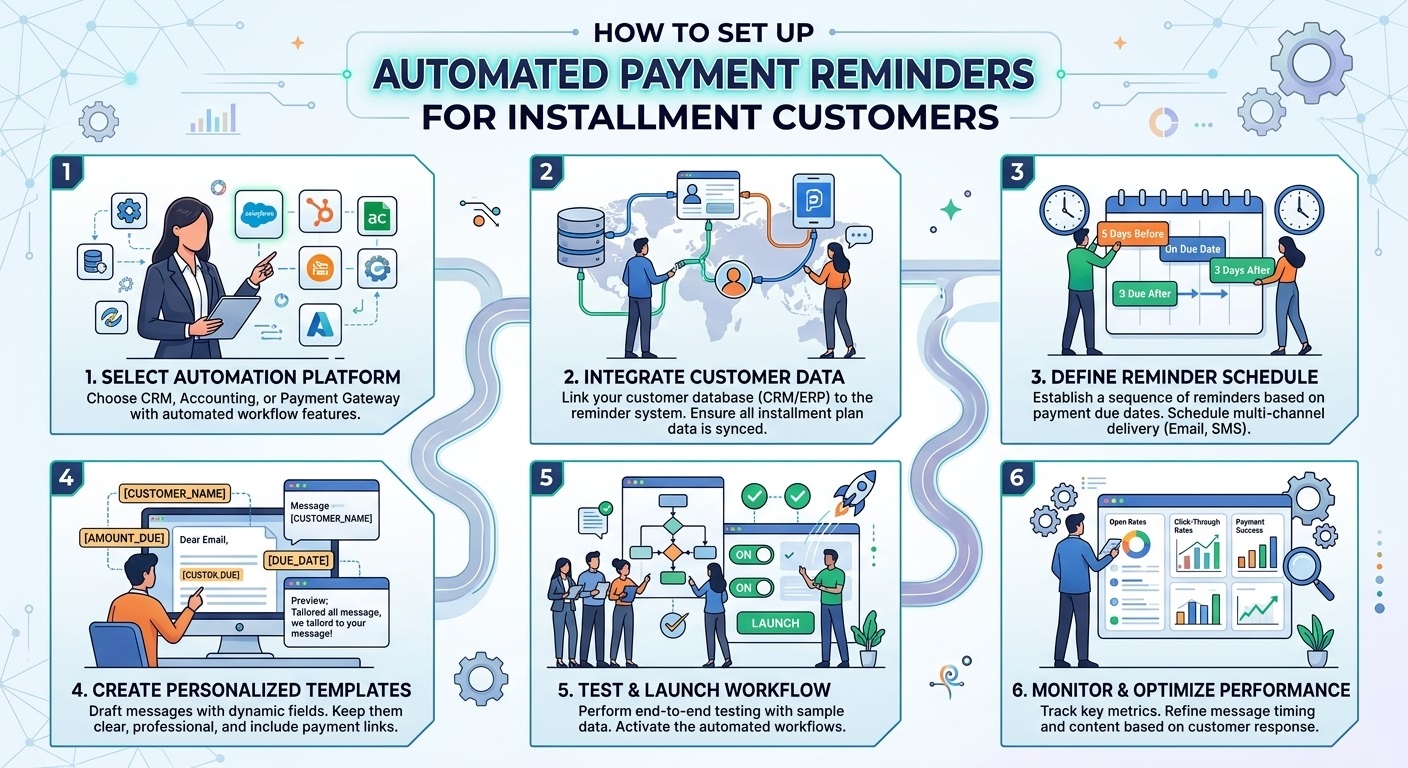
How to Set Up Automated Payment Reminders for Installment Customers
How to Set Up Automated Payment Reminders for Installment Customers
Getting reminders automated is one thing. Getting the timing, channel, and wording right is what actually determines whether customers act on them.
Most guides on automated payment reminders installment customers respond well to jump straight to the tool — pick a platform, connect WhatsApp, done. The tool is the easy part. The setup decisions that actually determine whether reminders work — when they go out, what they say, and which channel they use — get skipped far more often than they should be.
The three-stage cadence that works for most installment businesses
A single reminder on the due date catches customers who simply forgot that day. It misses everyone who needed a few days’ notice to have the cash ready, and it misses anyone who missed the first message entirely. A three-stage cadence covers all three cases without becoming excessive:
Why WhatsApp works well as the primary channel
WhatsApp reminders tend to get read faster than SMS for most Pakistani customers, and studies on payment reminder automation have found WhatsApp specifically can lift repayment rates by roughly 7-9% compared to no reminder at all. Part of that is simply reach — WhatsApp is where people already are, checked constantly through the day, in a way a text message sitting unread in a default SMS app sometimes isn’t.
Keeping the message itself short and specific
A reminder that reads like a form letter gets skimmed and forgotten. One that states the customer’s name, the exact amount, the exact date, and how to pay tends to get acted on. SMS in particular rewards brevity — messages under roughly 160 characters avoid getting split or truncated, and a reminder that fits in one clean message reads as more urgent than one that sprawls across several.
Trigger-based reminders, not just scheduled ones
Beyond the standard before/on/after cadence tied to a due date, some situations call for a reminder triggered by an event rather than a date — a partial payment that leaves a balance still outstanding, for instance, or an account that’s just crossed into a new overdue tier. These trigger-based reminders catch situations a purely calendar-based schedule would miss entirely, since they respond to what actually happened rather than assuming every account follows the same timeline.
Test the full sequence before relying on it. Run the three-stage cadence against a handful of real accounts first, checking that messages arrive at the right time with the right details filled in, before trusting it across the whole customer base.
What to avoid
- Too many reminders. More than three or four messages around a single due date starts to feel like harassment rather than a helpful nudge, and can push customers toward ignoring the channel altogether.
- Generic, unpersonalized text. A message with no name, no specific amount, and no specific date reads as spam, even when it’s technically accurate.
- One channel only, no fallback. Not every customer has WhatsApp, or keeps it reliably connected. SMS as a fallback catches the gap.
Setting it up once, correctly
The appeal of automating reminders is that the setup work happens once, and then runs consistently without daily manual effort. That’s only true if the initial setup is done properly — the cadence, the message templates, and the channel logic all configured correctly from the start. A rushed setup that gets “good enough” reminders out inconsistently ends up needing just as much manual oversight as no automation at all, which defeats the point of setting it up in the first place.
A configuration checklist worth running through once
Before switching a full customer base over to automated reminders, it’s worth running the complete setup against a small handful of test accounts first. Check that the before-due-date message actually arrives three days out as configured, not two or four. Confirm the due-date message reads correctly with the right name and amount pulled in automatically, rather than showing a placeholder or a formatting error. And verify the after-due-date message tone shifts appropriately — firmer than the first two, but not so aggressive that it damages a relationship with a customer who simply forgot once.
This kind of test run catches configuration mistakes while they only affect a few accounts, rather than discovering a broken template after it’s already gone out to the entire customer base. It’s a small amount of upfront effort that prevents a much larger cleanup later, and it’s the difference between automation that genuinely reduces manual work and automation that just moves the manual work to damage control.
Reminders that go out on time, every time
QistBook automates the full before/on/after cadence over WhatsApp and SMS, with templates ready to customize.
Schedule a DemoFrequently Asked Questions
How many automated payment reminders should be sent per installment?
Three is a reasonable default: one a few days before the due date, one on the due date itself, and one a few days after if payment hasn’t come in. More than that risks feeling like harassment; fewer often isn’t enough to catch genuine forgetfulness.
Should payment reminders be sent via WhatsApp or SMS?
WhatsApp tends to get read faster and feels less formal for most Pakistani customers, but SMS works as a reliable fallback for customers without WhatsApp or with unstable data connections. Many businesses use both.
What should an automated payment reminder message actually say?
Keep it short and specific: the customer’s name, the amount due, the due date, and how to pay. Long, generic messages get skimmed or ignored; short, specific ones get acted on.
Related reading

Umaira
I explore the people and processes behind successful installment businesses, including customer relationships, sales practices, staff workflows, and everyday challenges faced by retailers. Through my writing, I aim to present useful ideas and real-world approaches that make complex business practices easier to understand and apply in a busy retail environment.
View all posts →