
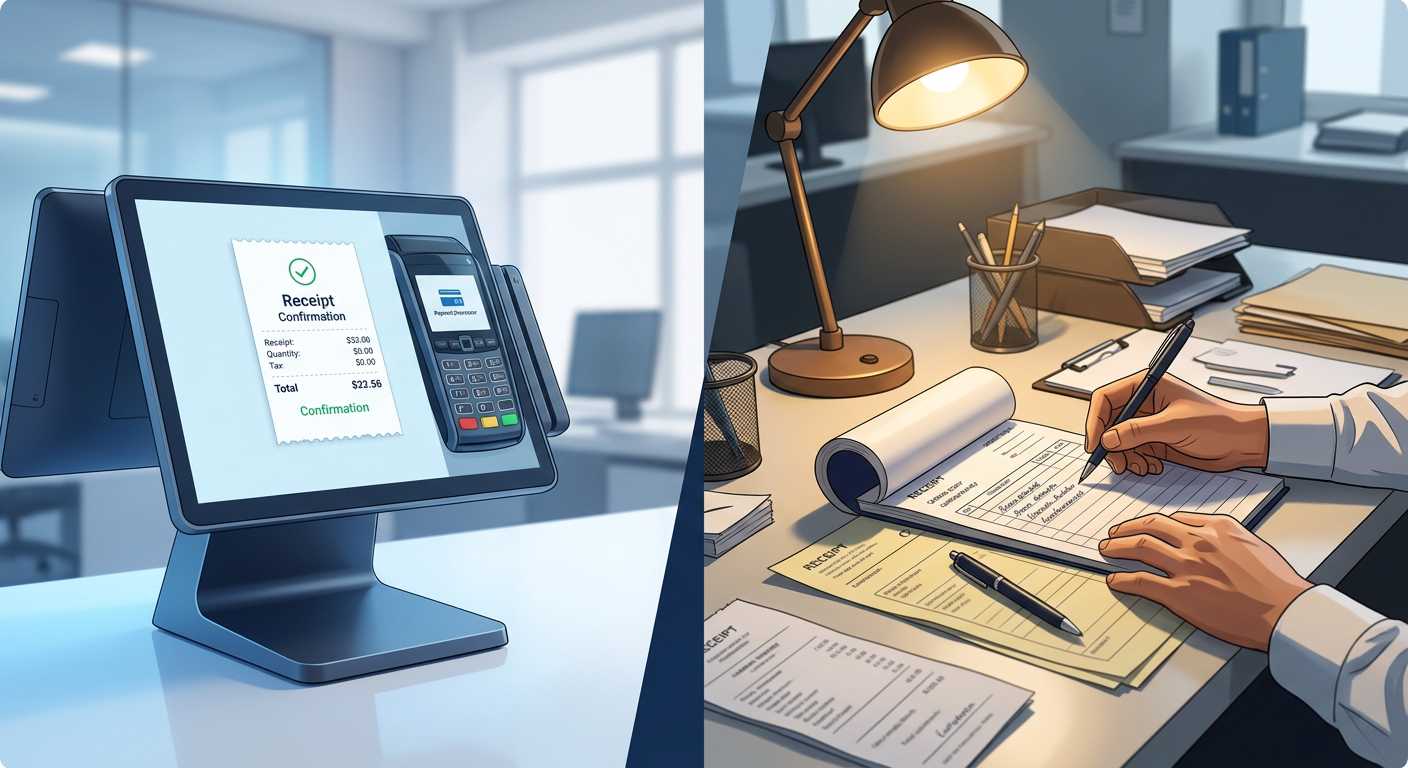
Digital Receipts vs Handwritten Receipts: Why It Matters for Installment Businesses
Most installment payments in Pakistan still end with a torn-off slip from a carbon-copy book — a customer’s copy, a shopkeeper’s copy, both filled in by hand in the time it takes to finish a sentence. It’s fast, it’s familiar, and for a single transaction, it works fine. The comparison between digital receipts vs handwritten receipts only really matters once a business is issuing hundreds of them a month, across dozens of overlapping installment plans, where consistency starts to count for more than speed.
What a receipt actually needs to hold up
Whether handwritten or digital, a receipt that actually protects both sides of a transaction needs the same core details: a date, the exact amount, who paid and who received it, the payment method, and what it was for. A slip that’s missing the date, or where the amount is smudged and ambiguous, is weak evidence regardless of format — the issue isn’t paper versus digital, it’s completeness.
Where handwritten receipts genuinely fall short
- Legibility fades. A receipt written quickly during a busy afternoon, read again eight months later during a dispute, is often harder to interpret than either party remembers.
- No automatic link to payment history. A paper slip proves one transaction happened. It doesn’t automatically connect to the other nine installments on the same plan, the remaining balance, or the customer’s overall record.
- Arithmetic is manual. Every remaining-balance calculation on a handwritten receipt is done by hand, in the moment, which is exactly the kind of repetitive task where small errors accumulate.
- One copy, one point of failure. If the shopkeeper’s copy is lost, damaged, or simply misfiled, the business’s own record of the transaction goes with it.
Legal validity was never really the issue. A handwritten receipt with complete, legible details can absolutely serve as proof of payment. The practical problem is that “complete and legible” is much harder to guarantee at scale, by hand, under time pressure.
What digital receipts change
A digital receipt calculates the remaining balance automatically, ties directly to the specific installment it applies to, and exists in at least two places — the customer’s copy and the business’s own system — the moment it’s generated. Sent over WhatsApp, it also arrives instantly rather than depending on a physical slip being kept safe in a wallet or drawer for months.
Where a dispute actually gets resolved
When a customer insists they’ve paid more than the records show, the resolution rarely comes down to “receipt exists or doesn’t.” It comes down to whether the receipt is part of a complete, consistent history — every prior payment, every balance update, all lining up. A single handwritten slip pulled out of a drawer, disconnected from anything else, is weaker evidence than a receipt that’s clearly one entry in an unbroken digital sequence covering the whole plan. That completeness, more than the format itself, is usually what settles the argument.
The honest middle ground
None of this means handwritten receipts are worthless, or that every business needs to digitize overnight. A single-counter shop issuing a handful of receipts a week can manage carbon-copy books reasonably well with discipline. The calculus shifts once volume grows — multiple branches, hundreds of active plans, staff who aren’t the owner handling transactions. At that point, the small inconsistencies that were manageable at low volume start compounding into real disputes and real losses.
What customers actually notice
There’s a trust dimension to this that’s easy to overlook in a purely operational comparison. A customer receiving a professional digital receipt — clear, itemized, arriving on WhatsApp within seconds — tends to read that as a sign the business is organized and takes the transaction seriously. A hastily scrawled slip, however legally valid, doesn’t send the same signal, even when nothing about the underlying payment terms is different. For a business trying to build a reputation for reliability in a market where installment fraud and disorganized shopkeepers are common complaints, that perception difference is worth something on its own, separate from the recordkeeping benefits.
It also changes how a customer behaves when something does go wrong. A customer holding a clear, complete digital receipt is far more likely to bring a genuine discrepancy calmly, because they trust the underlying system is accurate and the conversation is about resolving a real error rather than proving the payment happened at all. That’s a meaningfully easier conversation to have than one starting from “prove you actually received this.”
Every receipt, automatic and consistent
QistBook generates digital receipts tied to the exact installment and balance, sent instantly via WhatsApp.
Frequently Asked Questions
Are handwritten receipts legally valid for installment payments in Pakistan?
Yes, a handwritten receipt can be valid proof of payment as long as it includes the essential details — date, amount, payer, payee, and what the payment was for. The issue is rarely legality; it’s legibility, consistency, and whether a copy survives.
What makes digital receipts more useful than handwritten ones for installment businesses specifically?
A digital receipt is automatically linked to the customer’s account and payment history, calculated without manual arithmetic, and backed up — none of which a paper slip in a carbon-copy book provides on its own.
Can a digital receipt be disputed the same way a paper one can?
Yes, any receipt can be disputed. What matters is whether the record is complete and consistent with the rest of the payment history — a digital receipt tied to an auto-generated, unbroken sequence tends to hold up better than an isolated handwritten slip.
Related reading

Umaira
I explore the people and processes behind successful installment businesses, including customer relationships, sales practices, staff workflows, and everyday challenges faced by retailers. Through my writing, I aim to present useful ideas and real-world approaches that make complex business practices easier to understand and apply in a busy retail environment.
View all posts →