
How to Scale an Installment Business Across Multiple Branches
Scaling & Multi-Branch Ops
How to Scale an Installment Business Across Multiple Branches
A second location doubles the customers. It doesn’t automatically double the systems needed to manage them well — that part has to be deliberate.
Most installment businesses in Pakistan start with one counter, one owner who knows every customer, and processes that live mostly in that owner’s head. It works, right up until a second location opens and the owner discovers that managing an installment business across multiple branches requires everything they knew instinctively about the first branch to exist for the second one too — written down, communicated, and followed consistently by people who aren’t them.
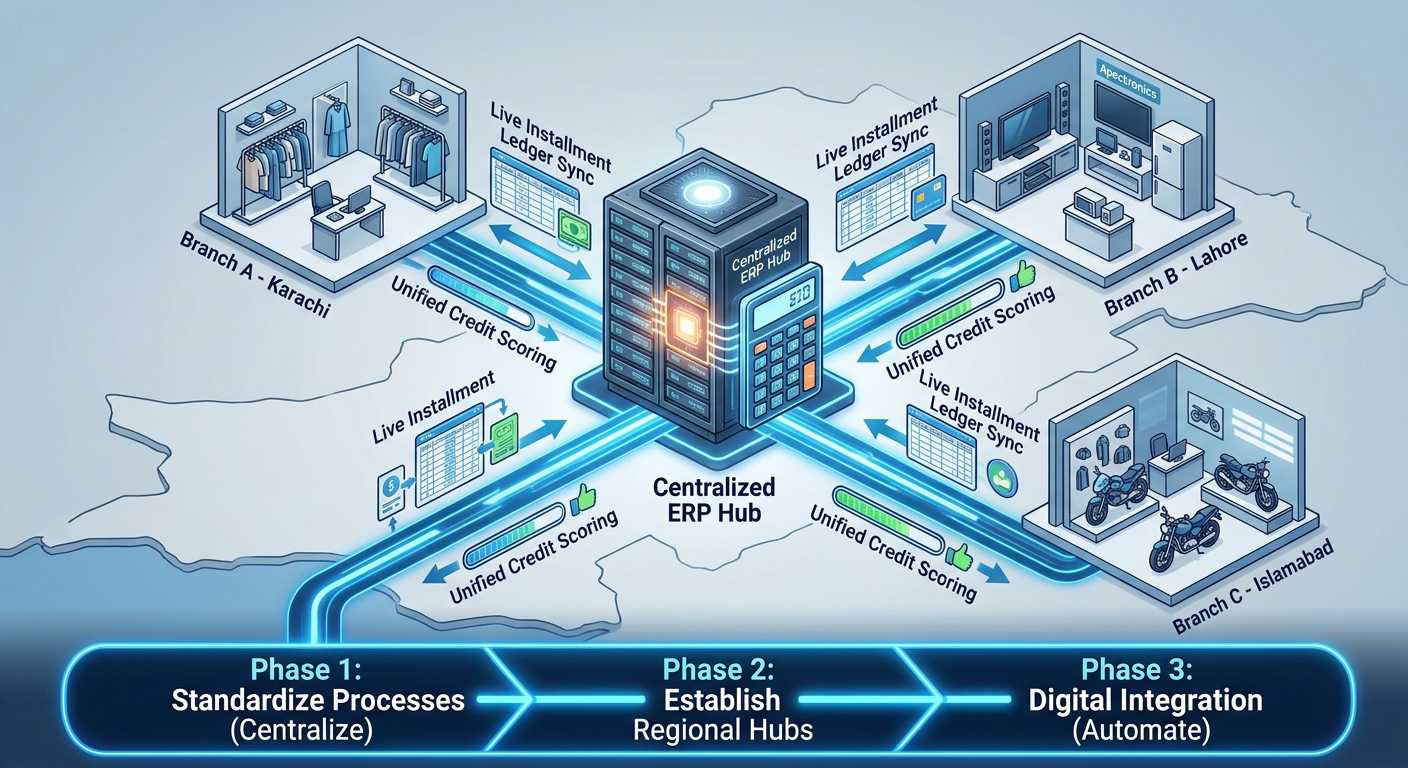
When you expand an installment business across multiple branches, operations naturally become more complex. Having reliable multi-location tracking tools and centralized software ensures that growth remains profitable without operational friction.
What actually needs to scale, beyond the obvious
Scaling an installment business across multiple branches is talked about like it’s mainly a real estate and staffing decision — find a location, hire a team, open the doors. Those matter, but the harder scaling problem is informational: making sure customer records, payment schedules, guarantor details, and recovery status are visible and consistent no matter which branch a customer walks into or which staff member is handling their account.
Reporting for an Installment Business Across Multiple Branches
A single-branch owner tracks performance by feel — they know if the week was good or bad without needing a report. That instinct doesn’t transfer to a second location they’re not standing in every day. Managing an installment business across multiple branches means head office suddenly needs an actual, deliberate reporting habit: consolidated collections, branch-by-branch comparison, and a way to spot a struggling location before it’s obviously struggling. Businesses that scale without building this reporting habit early tend to discover problems months later than they should have.
Pricing Rules for an Installment Business Across Multiple Branches
Letting each branch set its own installment terms independently sounds efficient in the moment — a branch manager closer to the local market makes a faster call. In practice, when operating an installment business across multiple branches, it creates two problems: customers who compare notes between branches and feel treated inconsistently, and a head office that can no longer easily reconcile numbers because every branch is technically running different rules. The better pattern, confirmed across multi-branch retail operations generally, is pricing and terms set centrally, with narrowly defined room for branch managers to adjust within approved limits — not open-ended discretion.
Untracked local exceptions compound fast. One branch manager quietly offering a longer payment plan to a friend’s relative seems harmless in isolation. Multiplied across several branches and months in an installment business across multiple branches, it becomes a pattern head office can’t see and can’t explain when the numbers don’t add up.
Staff Management in an Installment Business Across Multiple Branches
In a single-branch business, everyone effectively sees everything — there’s only one till, one register, one owner overseeing it all. Running an installment business across multiple branches changes that calculus. A branch manager needs full visibility into their own location. They generally don’t need to see another branch’s customer list, and definitely shouldn’t be able to edit another branch’s records. Getting this access structure right from the second branch onward saves a much harder retrofit later, once bad habits and overly broad access are already established.
Migrating from single-branch habits without losing what worked
The instinct when scaling is often to build entirely new processes for the new locations. A better approach usually preserves what worked at the original branch — the customer relationship habits, the recovery approach, the local market knowledge — while adding the structure that only becomes necessary once there’s more than one location to keep in sync. The goal of expanding an installment business across multiple branches isn’t replacing the founder’s original judgment with a rigid system; it’s making that judgment scalable to people who weren’t there when the business was built.
Signs a business is ready for a second branch
Beyond simple demand or an available location, a business is generally in a stronger position to open a second branch once its first location’s processes are stable enough to document and hand off — customer onboarding, recovery escalation, and reporting all following a repeatable pattern rather than depending entirely on the owner’s daily presence. Opening a second branch before the first one’s processes are solid tends to just multiply the disorganization rather than multiply the revenue.
What the first ninety days at a new branch actually reveal
The early weeks at a second location tend to surface exactly which of the original branch’s habits were genuinely systematic and which ones only worked because the owner was physically present to catch problems. A recovery process that ran smoothly at the first branch might stall entirely at the second, not because the process itself was wrong, but because it depended on judgment calls the owner made instinctively and never wrote down anywhere a new manager could reference. Treating the first ninety days at a new branch as a deliberate audit — what’s working without the owner there, and what quietly isn’t — tends to catch these gaps faster than assuming everything will simply transfer over.
This is also the point where a business finds out whether its reporting habit is real or aspirational. A head office running an installment business across multiple branches that intended to review consolidated numbers weekly but only actually gets around to it sporadically will feel the gap acutely once a second location is live — and that gap is exactly where problems go unnoticed longest.
One consolidated view, every branch
QistBook gives head office a single dashboard across every location, with branch-level access control built in.