
How to Segment and Prioritize Overdue Installment Accounts
How to Segment and Prioritize Overdue Installment Accounts
Not every overdue account deserves the same amount of attention on the same day. Here’s a practical way to sort them so your recovery effort actually goes where it matters most.
Most installment businesses handle overdue accounts the same way: someone opens the register or the spreadsheet, scrolls down the list, and starts calling from the top. It feels productive. It’s also usually the wrong order to work in.
A customer who’s three days late on a Rs 15,000 balance and has never missed a payment before doesn’t need the same urgency as a customer who’s forty days late on Rs 80,000 with no guarantor on file. Treating both the same way — same phone call, same day, same tone — wastes effort on the first case and delays action on the second one, which is exactly backwards.
Start with two numbers, not a gut feeling
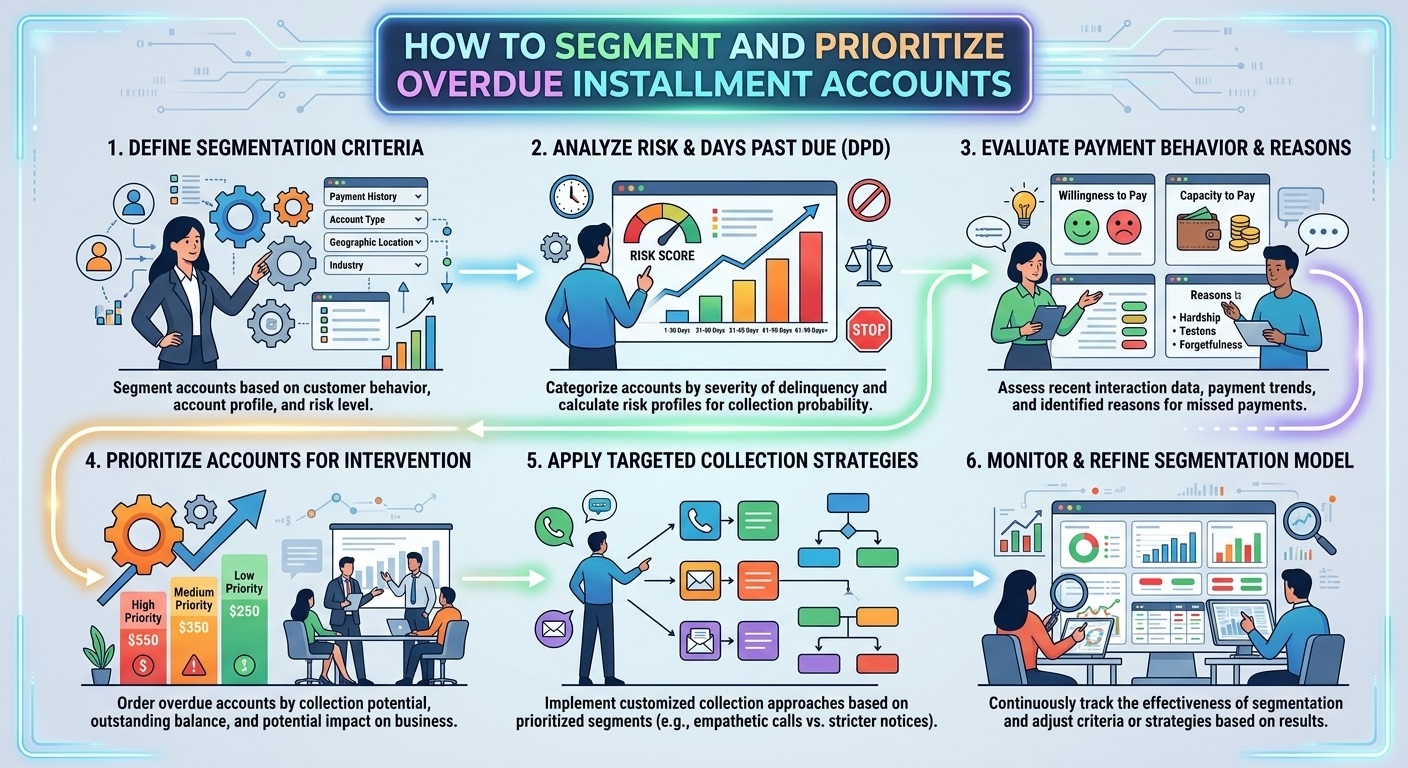
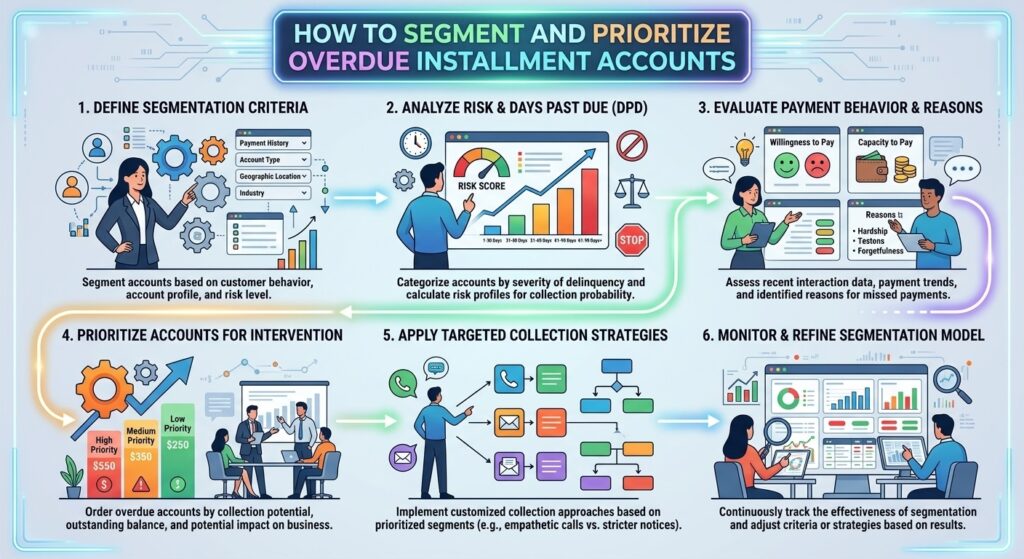
Segmenting overdue accounts doesn’t need to be complicated. Two numbers do most of the work: how many days late the account is, and how much money is actually at risk. Everything else — guarantor status, payment history, how many installments remain — refines the picture, but these two numbers alone are usually enough to sort a full overdue list into a sensible order.
A simple four-tier framework
Most retail installment businesses in Pakistan can work with four tiers without over-engineering the process:
- 11–7 days overdueAn automated WhatsApp or SMS reminder is usually enough here. Most customers in this tier pay within a few days on their own — a phone call at this stage often does more to annoy a good customer than to speed up collection.
- 28–30 days overdueThis is where a personal follow-up call makes sense. The reminder clearly wasn’t enough, and a direct conversation can surface whether it’s a cash-flow delay, a forgotten payment, or a sign of a bigger problem.
- 331–60 days overdueTime to involve the guarantor if one exists, and to consider a field visit if the balance is significant. An account that’s been quiet for a month despite calls is unlikely to resolve itself.
- 460+ days overdueFormal recovery steps — documented notices, guarantor liability, and in some cases legal consultation for high-value accounts. Waiting longer rarely improves the outcome at this stage.
Layer in balance size before you layer in anything else
Days overdue tells you urgency. Balance size tells you how much that urgency actually matters. A Rs 3,000 account that’s 15 days late and a Rs 90,000 account that’s 15 days late are not the same problem, even though they’d land in the same time-based tier. Most businesses find it useful to flag any account above a certain balance threshold for earlier attention, regardless of which day-based tier it technically falls into.
A practical rule of thumb: if the outstanding balance on an overdue account is large enough that losing it would meaningfully hurt the month’s cash flow, move it up a tier — don’t wait for the calendar to catch up.
Two mistakes that undo good segmentation
The first is treating the tiers as fixed once an account lands in one. An account that was Tier 2 last week but has now gone quiet after multiple missed calls needs to move to Tier 3, even if it hasn’t technically crossed the 31-day mark yet. Segmentation should reflect behavior, not just a calendar count.
The second is letting one person’s memory be the system. If prioritization depends on whoever’s handling recovery that day remembering which accounts are worse than others, the moment that person is sick or busy, the whole prioritization falls apart. The framework only works if it’s written down somewhere everyone on the team can see — which is usually the real argument for moving this off paper in the first place.
Guarantor status changes the math
An overdue account with a documented guarantor carries less risk than one without, simply because there’s a second person who can be contacted and who has some responsibility for the outcome. When sorting a recovery list, accounts without a guarantor — or with a guarantor whose contact details haven’t been verified recently — deserve to move up the priority list, even if the balance and days overdue look similar to a guaranteed account.
What this looks like without software
On paper or in a spreadsheet, this segmentation is possible but tedious — someone has to manually calculate days overdue for every account, cross-reference balances, and check guarantor records separately, every single day. It’s exactly the kind of repetitive sorting work that tends to get skipped when the shop gets busy, which is usually right when it matters most.
A connected system that already knows the due date, the balance, and the guarantor status for every customer can sort this automatically — surfacing the accounts that actually need attention today instead of requiring someone to reconstruct the picture from scratch each morning.
See prioritized recovery in action
QistBook’s recovery and defaulter tools sort overdue accounts by balance, days late, and guarantor status automatically — so the list is already in the right order.
Schedule a DemoFrequently Asked Questions
What is the best way to prioritize overdue installment accounts?
Segment overdue accounts by days late and outstanding balance first, then layer in guarantor status and payment history. High-balance, long-overdue accounts with no guarantor need attention before small, recently-late accounts with a strong payment record.
How many overdue tiers should a business track?
Three to four tiers is usually enough for most retail installment businesses: 1-7 days, 8-30 days, 31-60 days, and 60+ days. More tiers than that tends to add complexity without improving recovery outcomes.
Should every overdue account get a phone call?
No. A tiered approach works better — automated reminders for early-stage overdue accounts, and reserving phone calls or field visits for accounts that cross into higher tiers or show a pattern of repeated lateness.
Related reading

Umaira
I explore the people and processes behind successful installment businesses, including customer relationships, sales practices, staff workflows, and everyday challenges faced by retailers. Through my writing, I aim to present useful ideas and real-world approaches that make complex business practices easier to understand and apply in a busy retail environment.
View all posts →