
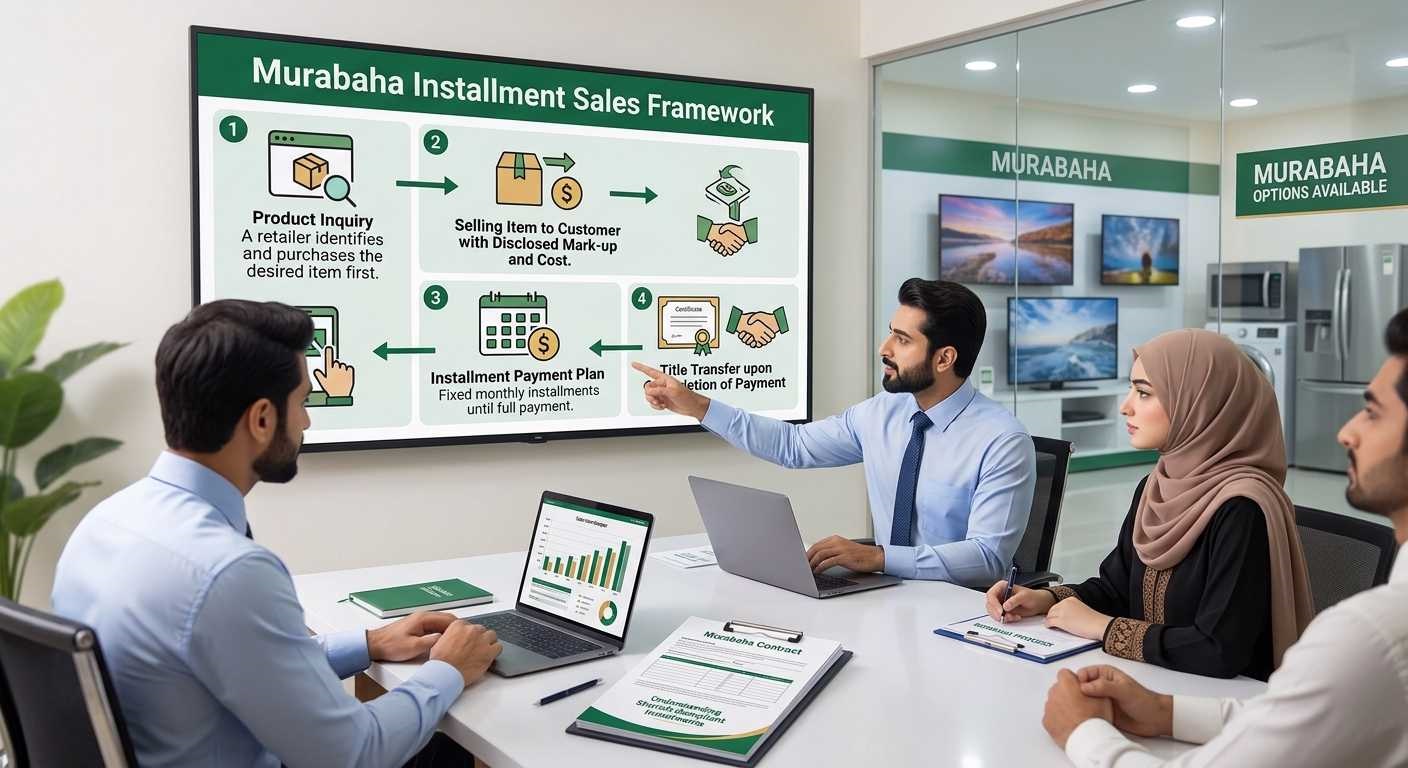
How to Structure Murabaha Installment Sales in Your Retail Business
The idea behind murabaha installment sales is simple to explain and slightly less simple to put into practice at a busy retail counter. Most shop owners who want to use this structure understand the core concept — sell the item at a fixed, disclosed price instead of lending cash with interest — but can struggle with the operational details: how the markup is disclosed, how the paperwork is worded, and how to avoid reintroducing something interest-like through a poorly designed late-fee policy. This guide explains the practical steps involved in structuring murabaha installment sales and documenting each transaction clearly.
This guide is the practical follow-up to our general halal installment business overview — a closer look at how to structure murabaha installment sales at the shop level. It includes a worked example, a step-by-step setup process for an Islamic installment structure, and common mistakes that can undermine a well-intentioned murabaha retail plan. Because murabaha installment sales depend on the actual transaction and its documentation, businesses should review both their sales process and contract wording before using this structure.
Same note as always: this is general educational content on common practice, not a religious ruling. Before marketing a plan as Shariah-compliant, have the actual structure and wording reviewed by a qualified Islamic finance scholar — the worked example below is illustrative, not a certified template.
A Worked Example of Murabaha Installment Sales
See how a cost-plus price disclosure can work in practice for murabaha installment sales.
Notice what the disclosure shows: the seller’s cost price, the stated profit margin, and the resulting fixed total — not a cash price plus a rate applied over time. In this example, Rs 78,000 remains the agreed sale price whether the customer pays over 6 months or 11 months. For murabaha installment sales, documenting the cost, markup, and final price helps make the transaction understandable to the customer. For background on the wider framework, consult the State Bank of Pakistan’s Islamic banking resources as well as a qualified Shariah advisor.
How to Set Up Murabaha Installment Sales in Your Business
Five practical steps to document and manage murabaha installment sales more carefully.
Establish and Document Your Actual Cost Price
Keep a clear record of what you actually paid your supplier for the specific unit — invoice, purchase record, or the purchase details captured in your accounting system. This is the basis of murabaha installment sales, so the cost should be supported by a real transaction rather than an estimate adjusted to make the markup look better.
Decide Your Markup as a Transparent, Disclosed Figure
Set your profit margin as an actual amount or percentage that you can explain openly to the customer — not a hidden figure buried inside a bigger cash price. Transparent disclosure is an important practical step when documenting murabaha installment sales, and it helps the customer understand how the final price was reached.
Fix the Total Price Before Any Payment Is Collected
For murabaha installment sales, cost plus markup gives you the fixed total sale price — this number goes into the agreement and does not move afterward, regardless of how the payment schedule actually plays out. Resist the temptation to quietly adjust it if a plan runs long; that’s exactly the drift that erodes the structure’s integrity.
Write the Agreement to Reflect a Sale, Not a Loan
The wording matters. The agreement should describe the sale of a specific item at a fixed price, rather than a cash advance with repayment terms. Clear wording is especially important for murabaha installment sales, so have a qualified Shariah advisor review the agreement and the actual transaction process.
Decide Your Late-Payment Approach Before You Need It
As covered in our broader halal installment guide, this is genuinely debated ground — get advice specific to your business on whether to charge a flat penalty, route it to charity, or skip a late fee entirely, and apply that decision consistently once it’s made.
Common Mistakes in Murabaha Installment Sales
Well-intentioned businesses often drift back toward interest-like structuring without realizing it — here’s where that usually happens.
Quietly raising the “remaining balance” if a customer takes longer to pay than expected.
Keep the total fixed regardless of timeline — handle genuine lateness through a separate, pre-agreed late-fee policy only.
Presenting only a single “cash price” without ever showing the underlying cost and markup separately.
Disclose cost price and profit margin as two distinct figures, even if only on request or in your own records.
Selling an item you don’t actually own or haven’t taken possession of yet, as if it were already yours to sell.
Complete your own purchase and take genuine ownership before reselling the item to the customer.
A late fee that increases the longer a payment is overdue, calculated like ongoing interest.
Use a flat, one-time charge if any late fee applies at all — no compounding, no growth over time.
Configure Fixed Pricing and Custom Terms in QistBook
Set a fixed total price per customer, disclose cost and markup in your own records, and define your own late-payment policy — QistBook adapts to the structure your business has decided to use.
Getting murabaha installment sales right is less about memorizing a formula and more about building a consistent process for pricing and documentation. When cost price, disclosed markup, and the fixed total are recorded for every sale, the business has a clearer basis for explaining the agreement and reviewing its practices. Have the full structure checked by a qualified advisor, especially before presenting a plan as Shariah-compliant.
Frequently Asked Questions
Explore More from QistBook

Ahsan
I focus on the practical side of running a credit-based retail business, with a particular interest in customer verification, guarantor management, recovery procedures, and reducing the risks associated with installment sales. I share practical guidance based on the situations retailers commonly face, helping business owners build stronger processes for approving customers and handling credit responsibly.
View all posts →