
10 Profitable Installment Business Ideas in Pakistan

Installment (qist) selling is one of the most reliable small-business models in Pakistan for one reason — most consumers still cannot access formal bank credit for everyday purchases. With only around 64% of adults holding a bank account, a large share of the population buys mobile phones, motorcycles, appliances, and even school fees on qist through the retailer or agent directly. That gap is where a well-run installment business earns its margin.
This guide lays out the most profitable installment business ideas Pakistan entrepreneurs are running in 2026 — across mobile retail, auto, furniture, solar, property, and education. Each idea below shows the typical ticket size, plan length, starting capital, and difficulty so you can match a category to your own budget and appetite for risk. Toward the end, a comparison table summarises all 10 side-by-side, and we cover where a platform like QistBook fits once your customer count outgrows the register.
Sources: SMEDA Research on SMEs in Pakistan; State Bank of Pakistan National Financial Inclusion Strategy; Pakistan Telecommunication Authority Annual Report 2024–25; industry benchmarks reported by Pakistani installment retailers.
The best qist business ideas in Pakistan share three traits: predictable customer demand, a ticket size that matches the buyer’s income cycle, and inventory that holds enough resale value to anchor recovery if things go wrong.
10 Profitable Installment Business Ideas in Pakistan for 2026
Ten viable installment business ideas Pakistani entrepreneurs are running today — sorted from lowest to highest capital requirement.
Mobile Phone Retail on Installments
Mobile shops are the most common entry point into installment selling — high inventory turnover, familiar buyer behaviour, and IMEI numbers give you a clear identifier for every unit sold. Plans typically run 3–6 months, which keeps your capital recycling fast compared to bigger-ticket categories.
The main risk is fast-moving depreciation on unsold stock and the temptation to skip verification when the customer is a “walk-in regular”. Apply the same CNIC and guarantor checklist to every sale, not just the higher-ticket ones.
Home Appliances (Fridge, AC, Washing Machine)
Appliances are a family purchase — decisions are made by two or three people, tickets are larger than mobiles, and repeat business comes through referrals from satisfied customers. Wedding season and summer AC demand are your two big annual spikes to plan inventory around.
Brand relationships matter more here than in mobile retail. Getting authorised-dealer status with one or two major brands gives you better markup, warranty leverage, and a stronger recovery story if a unit needs servicing during the payment period.
Consumer Electronics (LED TVs, Audio, Gaming)
LED TVs, home theatres, gaming consoles, and speaker systems sell steadily year-round with clear seasonal spikes around cricket tournaments, Ramzan transmissions, and Eid gifting. Tickets are moderate and plan lengths short, which keeps your working capital moving.
The risk is category obsolescence — models refresh fast and unsold inventory loses value quickly. Focus on the 4–5 fastest-moving SKUs rather than trying to stock the full brand catalogue at launch.
Laptops & IT Equipment for Students & Freelancers
Pakistan’s freelance and remote-work economy has created a durable market for laptop installments among students, IT trainees, and remote workers who need equipment before their first paycheck. Sales cluster around university admission season and course-start months.
This is a solid small business installment model for anyone with an IT retail background — inventory concentration is on a handful of well-known models, and the buyer is usually more financially literate than a general-consumer segment.
Small Business Equipment (Sewing Machines, Freezers, Generators, Ata Chakki)
Selling productive equipment to other small businesses is one of the most stable installment models in Pakistan — because your customer uses the item to earn income, they have a strong incentive to keep payments current. Sewing machines, deep freezers, generators, water pumps, and ata chakki units all fit this pattern.
B2B customers generally document better than consumers, which shortens your verification cycle, and your recovery story is stronger because the equipment itself is the source of the customer’s cash flow.
Furniture & Home Setup on Qist
Furniture is a shadi-season powerhouse — full bedroom sets, sofas, and dining suites often go out on 6–12 month plans, and dowry-driven demand keeps volumes strong even in slow retail months. Margins here are among the best on this list, particularly on custom orders.
The category ties up capital longer than mobile or electronics, and quality complaints during the payment window can quickly turn into payment disputes. A clear post-sale service commitment protects both recovery and reputation.
Motorcycle & 2-Wheeler Showroom Installments
Motorcycles are the workhorse of daily commuting in Pakistan, and installment selling is how the vast majority of buyers actually acquire them. Chassis and engine numbers give you unique identifiers to track each unit, and registration paperwork can be structured to protect your interest until final payment.
This is a longer capital cycle than retail — 12–24 month plans are common — so cash flow planning matters more here than in any category above. A strong guarantor process is non-negotiable.
Solar Panels & Home Battery Systems
Persistent load-shedding and rising electricity tariffs have made rooftop solar one of the fastest-growing installment categories in Pakistan. A typical residential system sits in the Rs 200,000–800,000 range and pays for itself in 2–4 years, which makes the customer’s incentive to keep paying naturally strong.
The category demands technical competence — installation, net metering paperwork, and after-sales servicing all sit inside your responsibility. Partner with a reliable installer if you do not have that capability in-house.
Educational Course Fee Financing
Universities, IELTS/PTE prep centres, medical entry-test academies, and professional certifications (ACCA, PMP, digital-skills bootcamps) all have students who can pay in monthly installments but not upfront. Financing these fees on qist is a genuinely underserved small business installment model with predictable demand cycles tied to admission seasons.
The customer relationship here is different — you are effectively financing a service, not a product you can repossess. Strong CNIC + guarantor + parent-co-signer processes are essential, and partnering directly with the institution for enrollment verification lowers default rates significantly.
Property Plot Files & Housing Society Installments
Plot file installments are the highest-ticket, longest-cycle installment business in Pakistan — plans regularly run 24–60 months, with balloon and possession-linked payments layered on top of the monthly qist. Housing societies, developers, and property dealers all run installment structures at scale.
This is the most complex category on the list. You need legal expertise, dealer network relationships, and industrial-grade record keeping — this is where dedicated installment software stops being optional and becomes the operating spine of the business.
Compare All 10 Installment Business Ideas
A quick side-by-side of the key numbers — use it to match a category to your available capital and risk appetite.
| # | Business Idea | Ticket Size | Plan Length | Start Capital | Margin | Difficulty |
|---|---|---|---|---|---|---|
| 1 | Mobile Phones | Rs 20K–150K | 3–6 mo | Rs 500K+ | 15–25% | Low |
| 2 | Home Appliances | Rs 40K–200K | 3–9 mo | Rs 1M+ | 12–20% | Low–Med |
| 3 | Consumer Electronics | Rs 30K–250K | 3–9 mo | Rs 800K+ | 12–20% | Low–Med |
| 4 | Laptops & IT | Rs 60K–200K | 3–9 mo | Rs 1M+ | 10–20% | Low–Med |
| 5 | Business Equipment | Rs 30K–500K | 3–18 mo | Rs 1M+ | 15–25% | Medium |
| 6 | Furniture | Rs 60K–500K | 6–12 mo | Rs 1.5M+ | 20–35% | Medium |
| 7 | Motorcycles | Rs 120K–300K | 6–24 mo | Rs 3M+ | 8–15% | Medium |
| 8 | Solar Systems | Rs 200K–800K | 6–24 mo | Rs 2M+ | 15–25% | Medium |
| 9 | Course Fees | Rs 30K–500K | 3–24 mo | Rs 500K+ | 15–25% | Medium |
| 10 | Property Files | Rs 500K–5M+ | 12–60 mo | Rs 10M+ | 20–40% | High |
Run Any of These Installment Businesses on QistBook
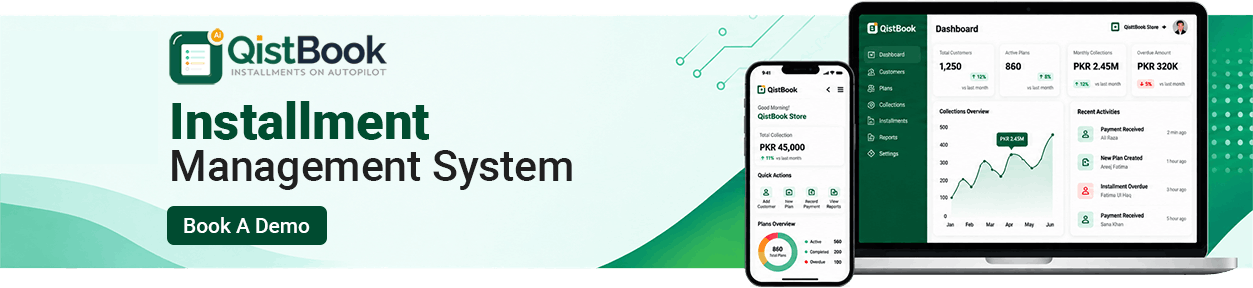
QistBook is a cloud-based installment management platform built for Pakistani businesses — automating installment schedules, WhatsApp and SMS reminders, guarantor records, and recovery tracking across every category on this list, so you spend less time chasing payments and more time growing.