
How to Start an Installment Business in Pakistan (2026 Guide)

From Hall Road in Lahore to Saddar in Karachi, a large share of Pakistani retail runs on one arrangement — the customer pays a portion today and the balance in monthly installments. Selling on qist is not a fringe model here; it is how mobile phones, motorcycles, appliances, and furniture reach most buyers. With only around 64% of adults holding a bank account, most consumers cannot walk into a bank for a loan on a Rs 60,000 phone or a Rs 180,000 bike — so the shop itself becomes the financier.
If you are working out how to start an installment business in Pakistan, this guide covers the 8 practical steps that decide whether your qist operation stays profitable — niche selection, working capital, licensing, guarantor process, agreement drafting, and choosing the right tools. Toward the end, we cover the risks that catch new entrants off guard and where a platform like QistBook fits once your customer count outgrows the register.
Sources: SMEDA Research on SMEs in Pakistan; State Bank of Pakistan National Financial Inclusion Strategy; Pakistan Telecommunication Authority Annual Report 2024–25; industry recovery benchmarks reported by Pakistani installment software providers.
8 Steps to Start an Installment Business in Pakistan
A practical framework drawn from how real mobile shops, electronics dealers, bike showrooms, and property agents run qist sales across Pakistan today.
Pick a Focused Niche You Actually Understand
Installment businesses win by going narrow. Mobile phones, appliances, furniture, motorcycles, solar systems, and school fee plans all sell well on qist — but each has its own price band, income profile, and default pattern. Trying to run several from day one spreads your capital and attention too thin to be good at any.
Before committing, look at what already sells on qist in your area, what markup the market accepts, and where you have supplier relationships or genuine product knowledge. A narrower niche is easier to price and to recover on than a broad one you are still learning.
Plan Your Installment Business Capital and Cash Buffer
The biggest mistake new entrants make when they start a qist business in Pakistan is underestimating working capital. Unlike a cash shop, you hand over the product today but collect its value over 3 to 12 months — so your installment business capital must cover two things: enough inventory to keep selling, plus a cash buffer to run the shop while earlier customers are still paying.
As a rule of thumb, plan for 2–3 months of operating expenses on top of initial stock. A mobile shop can start on a lower base than a furniture or bike business, where each sale ties up more capital for longer.
Handle Registration and Installment Business Licensing
Even a small qist shop benefits from proper installment business licensing from day one. The essentials are an NTN from the FBR, a local trade license from your city authority, and sales tax registration if your turnover crosses the threshold. If you plan to bring in partners later, register as a company with SECP rather than staying a sole proprietorship.
Skipping this feels harmless at first but becomes expensive later — enforcing a contract, opening a business bank account, or applying for trade financing all require these registrations already in place.
Structure Down Payment, Markup, and Plan Length
Three levers decide both your margin and your default rate: down payment size, markup method, and plan length. Most Pakistani qist shops take a 20–30% down payment and spread the balance over 3, 6, or 12 months — the down payment reduces your risk, and matching plan length to the customer’s income cycle keeps defaults down.
Markup is usually a flat rate on the cash price. Be transparent about the total the customer will pay — surprise arithmetic later is the fastest way to create disputes and drive up recovery costs.
Build a Rigorous Customer and Guarantor Verification Process
This is the highest-leverage step, and the one new businesses most consistently rush. At minimum: verify the buyer’s CNIC, check whether it exists in your database as a prior defaulter, take a guarantor with their own CNIC and a genuine relationship to the buyer, and confirm the customer’s income actually supports the plan.
Most losses in Pakistani qist businesses trace back to weak onboarding, not bad luck. Apply the same checklist to every sale — a structured guarantor process pays for itself many times over.
Draft a Clear, Enforceable Installment Agreement
Every installment sale should be backed by a written agreement — ideally on stamp paper for higher-ticket items. This gives your recovery real legal standing if a customer disputes the balance. State the total amount, payment schedule, late-fee (jurmana) percentage, default consequences, and the guarantor’s obligations.
Write terms in plain language the customer can understand, and walk through them verbally with both buyer and guarantor. Keep a signed original for your customer file and hand a copy to the buyer.
Set Reminder Cadence, Recovery Rules, and Late-Fee Policy
Decide your jurmana policy before your first sale and communicate it clearly at signing — not after a payment is late. A workable cadence: a message 2–3 days before the due date, another on the due date, a polite follow-up 3 days after, then escalate to a call or visit.
Most customers who miss a payment are not trying to avoid it — a timely WhatsApp or SMS reminder resolves most delays on its own. Reserving doorstep visits for genuinely overdue accounts protects the customer relationship from breaking over a one-off slip.
Choose the Right Tools — From Register to Installment Software
Most installment shops start on a notebook or Excel sheet, and at low volume that is fine. Problems begin around 50–100 active customers: due dates get missed, customers dispute balances because there is no clean record, and guarantor paperwork goes missing exactly when you need it for a recovery call.
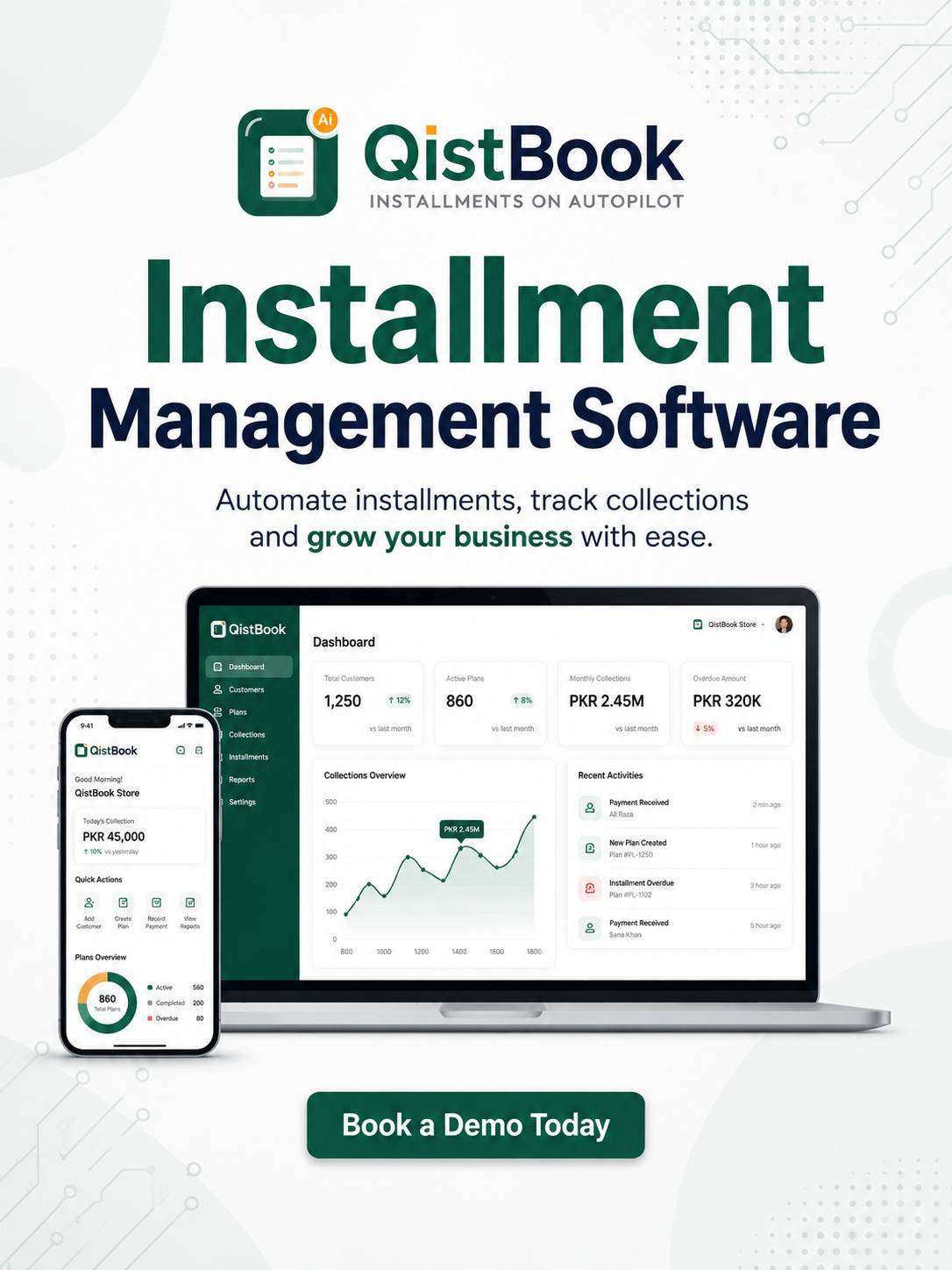
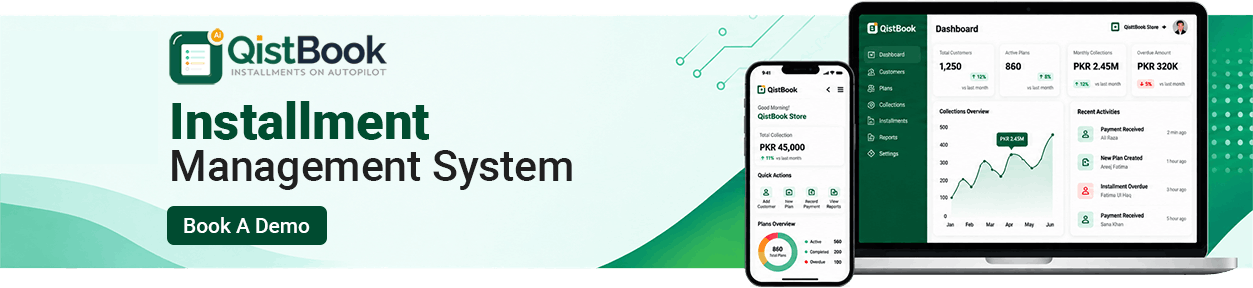
This is the point to move to dedicated installment software — a system built to generate schedules, send reminders on time, and keep every customer, guarantor, payment, and document searchable in one place. It is exactly the gap QistBook fills for Pakistani installment businesses.
Run Your Installment Business on Autopilot with QistBook
If you’re ready to start an installment business in Pakistan — or already run one — QistBook is a cloud-based installment management platform built for Pakistani businesses: automating installment schedules, WhatsApp and SMS reminders, guarantor records, and recovery tracking, so you spend less time chasing payments and more time growing.